

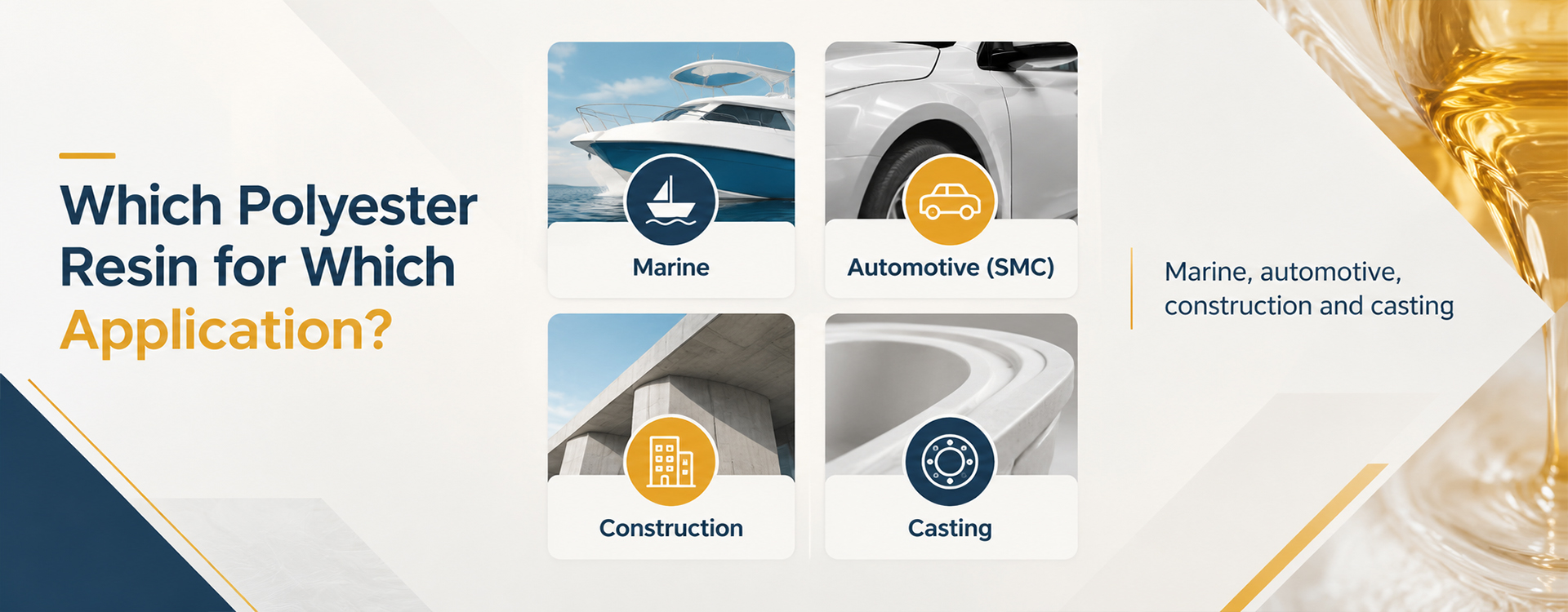
The right resin is decided by what the finished part has to survive, and how it is made. A boat hull and a shirt button are both polyester, but they ask opposite things of the resin. This guide walks through the main end-uses we supply, what each one demands, and which resin family usually fits. Use it to narrow your shortlist, then confirm with the data sheet and a trial on your own process.
Start from two questions
Every application comes down to two questions.
- What will the part face in service? Water, chemicals, heat, sunlight, fire, impact, or nothing demanding.
- How is it made? Hand lay-up, spray-up, compression moulding, casting, grouting, dispersion.
The first question picks the backbone. The second picks the viscosity, reactivity and accelerator status. Our articles on the resin backbone and the grade code explain both in more depth.
Marine
Boats, jetties and anything that sits in water for years need resistance to water absorption. Water slowly working into a laminate can cause blistering, a common marine failure. That is why isophthalic chemistry is the ideal default for marine laminates and outdoor gelcoats (Note: for price sensitive customers, orthophthalic options may also be considered). The surface layer matters as much as the laminate: a gelcoat takes the sun, abrasion and water first. See our article on gelcoat vs laminating resin.
Automotive: SMC and DMC
Sheet moulding compound (SMC) and dough moulding compound (DMC) are pre-mixed blends of resin, filler and glass fibre, moulded under heat and pressure. They are used for body panels, electrical enclosures and under-bonnet parts. The process needs a resin that stays stable during compounding, then cures fast and fully in a hot press. That calls for a high-reactive resin, usually isophthalic when mechanical and heat performance matter. Our range lists VRP 3115, a high-reactive isophthalic resin for SMC and DMC, and VRP 3116, a medium-reactive isophthalic resin, both tagged for automotive use.
Construction and infrastructure
Construction uses resin in grouting and anchoring, panels, gratings and cladding. The demands vary.
- Grouting and anchoring need controlled, reliable cure in the field, often at site temperatures. Our range lists VRP 3117, an isophthalic resin for grouting, supplied with a promoter to support cure.
- Building panels and public infrastructure may carry a fire-performance requirement. Fire-retardant resins, such as VRP 2128, are formulated for this. The rating that matters depends on the test standard your project specifies. We will cover fire-retardant resins in a separate article.
Casting: buttons, stone and decorative parts
Casting pours resin into a mould as a solid mass, without reinforcement. That puts different demands on the resin: hardness, low shrinkage, controlled heat build-up in thick sections, and often colour or clarity.
- Buttons need a hard, machinable cured resin. Our range includes VRP 2125 (orthophthalic) and VRP 1122 (terephthalic) button grades.
- Engineered stone and marble need a clear resin that carries a high filler load. VRP 2219 is an orthophthalic clear-cast resin, supplied pre-accelerated.
- Decorative parts and trimmings, including metal putty, use terephthalic grades such as VRP 1112 for their rigidity and value.
Pigment pastes
Pigment pastes are concentrated colour dispersions that manufacturers add to resin or gelcoat. The base resin must disperse pigment well and should not add styrene to the final mix. VRP 2124 (orthophthalic) and VRP 1114 (terephthalic) are styrene-monomer-free grades designed as pigment-dispersion bases; 2124 is also a flexible grade.
General FRP fabrication
Tanks for non-aggressive contents, general panels, covers and moulded parts with mild service conditions are well served by orthophthalic or terephthalic resins. Orthophthalic is the widely used, economical choice. Terephthalic adds rigidity and heat performance at good value. DCPD-modified resins, such as VRP 4110 and its ultra-low-viscosity variant 4110-ULV, suit work where easy wet-out, low shrinkage and a clean surface matter most.
Quick Reference
| Application | What it demands | Usual family | VRP grades listed for it |
|---|---|---|---|
| Marine laminates and gelcoats | Water and weather resistance | Isophthalic (Ortho for price-sensitive customers) | See flag above |
| Automotive SMC / DMC | Fast, full cure under heat | Isophthalic, high or medium reactive | 3115, 3116, 3116 Gelcoat |
| Grouting and anchoring | Reliable field cure | Isophthalic with promoter | 3117 |
| Fire-rated panels | Fire performance to a stated test | Fire-retardant grades | 2128, 1128 |
| Buttons | Hardness, machinability | Orthophthalic or terephthalic | 2125, 1122 |
| Stone and marble | Clarity, high filler load | Orthophthalic clear cast | 2219 |
| Pigment pastes | Pigment dispersion, no styrene | Styrene-free grades | 2124, 1114 |
| General FRP | Cost, easy processing | Ortho, tere or DCPD | 2110, 2210, 1110, 1210, 4110 |
The families above are typical starting points, not rules. Actual fit depends on your process, reinforcement and cure schedule. Always confirm against the grade’s TDS and a trial.
At Vikram Resins
We supply manufacturers across marine, automotive, construction, casting and composites, and make all four resin backbones plus gelcoats. Tell us the part, its service conditions and your process, and we will recommend the grade that fits. Browse the full range and request a data sheet, or contact our technical team.
FAQs
Which resin is best for boats?
Isophthalic resin is the usual default for marine laminates and outdoor gelcoats, because of its better resistance to water and weather. Orthophthalic resins can also be used in specific cases.
What resin is used for SMC?
SMC needs a high-reactive resin that cures fast and fully under heat and pressure. Isophthalic is common where mechanical and heat performance matter.
What resin is used for buttons?
Button casting needs a hard, machinable cured resin. Orthophthalic and terephthalic button grades are both used.
Can I use general-purpose resin for a water tank?
It depends on what the tank holds and where it sits. For long-term water contact, isophthalic is usually the safer choice. Share your service conditions and we will advise.
What is a styrene-free resin used for?
Mainly as a base for pigment pastes, where extra styrene in the final mix is unwanted.