

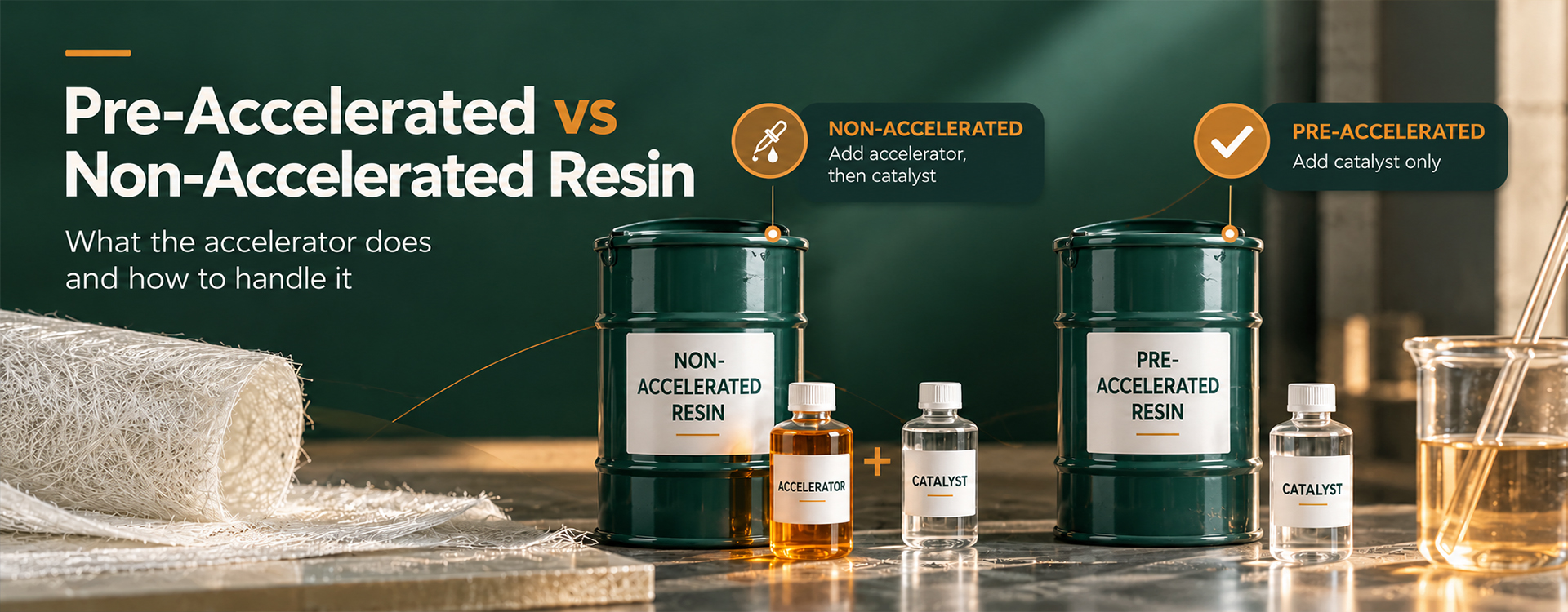
Unsaturated polyester resin does not cure on its own at room temperature. It needs two additions: a catalyst to start the reaction, and an accelerator to make that catalyst work at shop temperature. You can buy resin with the accelerator already mixed in, called pre-accelerated, or without it, adding the accelerator yourself. The choice affects convenience, control over working time, shelf life and safety. This guide explains the difference and how to decide.
Catalyst and accelerator: two different jobs
The two words are often confused, and the confusion causes accidents.
- The catalyst, strictly an initiator, is usually an organic peroxide, most often methyl ethyl ketone peroxide (MEKP). It produces the reactive fragments that start the resin curing.
- The accelerator, typically a cobalt compound, makes the peroxide break down quickly at room temperature. Without it, the catalyst would act far too slowly to be useful in an unheated mould.
You need both for a room-temperature cure. The accelerator controls how fast the catalyst works; the catalyst dose controls how much curing reaction there is.
Some grades also include a promoter, an additional ingredient that helps the accelerator work faster or more reliably, for example at lower temperatures. In a VRP grade code, a promoter is shown by 7 as the fourth digit.
Safety first: never mix accelerator and catalyst directly
Cobalt accelerator and peroxide catalyst react violently when they meet undiluted. Mixed directly, they can cause fire or an explosion. Always mix the accelerator fully into the resin first, then add the catalyst. Store and handle the two apart, with separate measuring tools. Follow the MSDS for every product you use.
This is one of the practical advantages of a pre-accelerated resin: the accelerator is already safely dispersed, so there is one fewer hazardous liquid on the shop floor.
Non-accelerated resin
With a non-accelerated resin, you add both accelerator and catalyst at the point of use.
Advantages:
- Control over gel time. You can adjust the accelerator dose to suit the day’s temperature, the size of the part, or the working time you need.
- Longer shelf life. With no accelerator present, the resin is generally more stable in storage.
- Flexibility. One resin can serve several processes with different cure speeds.
Trade-offs:
- One more material to buy, store, measure and handle safely.
- More room for error. Uneven mixing or wrong doses cause patchy cure, slow cure or excessive heat.
Pre-accelerated resin
With a pre-accelerated resin, the accelerator is already in the drum. You add only catalyst.
Advantages:
- Simpler and faster at the point of use, with fewer measurement steps.
- More consistent cure, because the accelerator dose is set and dispersed at the factory.
- Safer handling, with no separate cobalt accelerator on site.
Trade-offs:
- Less control. Gel time is adjusted only through catalyst dose and temperature.
- Pre-accelerated resins are generally less stable in storage. Heat shortens their life further. Store cool, out of direct sun, and use stock in date order.
- A different MSDS. The accelerator adds hazard information, so the safety data sheet differs from the non-accelerated version of the same chemistry.
Quick Reference
| Factor | Non-accelerated | Pre-accelerated |
|---|---|---|
| What you add | Accelerator, then catalyst | Catalyst only |
| Control over gel time | High, via accelerator and catalyst dose | Moderate, via catalyst dose |
| Mixing steps | More | Fewer |
| Risk of dosing error | Higher | Lower |
| Shelf life | Stable | Need more care |
| Separate accelerator on site | Yes | No |
| MSDS | Resin hazards | Resin plus accelerator hazardsResin plus accelerator hazards |
| Second digit in VRP code | 1 | 2 |
How to choose
Choose non-accelerated if you need to tune cure speed often, run several processes from one resin, hold stock for longer periods, or already have trained staff and safe systems for handling accelerator.
Choose pre-accelerated if you want a simpler, more repeatable shop process, run one process consistently, use stock steadily, or want to remove cobalt accelerator from the shop floor.
Reading it in the VRP grade code
The second digit of a VRP grade code tells you accelerator status: 1 means supplied without accelerator, 2 means pre-accelerated. Several grades come in both versions. For example, VRP 2110 is our general-purpose orthophthalic resin, and VRP 2210 is the same family supplied pre-accelerated. VRP 1110 and VRP 1210 are the equivalent terephthalic pair. See How to Read a VRP Grade Code.
At Vikram Resins
We offer both versions across several families, so you can choose based on your process rather than on what one supplier stocks. Tell us your process, shop temperature and working time, and we will recommend the right version. Browse the full range, request the TDS and MSDS, or contact our technical team.
FAQs
What is a pre-accelerated resin?
A polyester resin supplied with the accelerator already mixed in. You add only the catalyst to start the cure.
What is the difference between an accelerator and a catalyst?
The catalyst, usually MEKP, starts the curing reaction. The accelerator, typically a cobalt compound, makes the catalyst work at room temperature.
Can I mix cobalt accelerator and MEKP together?
Never directly. They react violently and can cause fire or explosion. Mix the accelerator into the resin first, then add the catalyst.
Do pre-accelerated resins have a shorter shelf life?
VRP’s pre-accelerated resins have the same shelf life as their non-accelerated counterparts. But it is critical to store them cool and out of direct sun, and use stock in date order. Check the TDS for the grade’s shelf life.
How do I tell if a VRP grade is pre-accelerated?
Look at the second digit of the grade code: 2 means pre-accelerated, 1 means supplied without accelerator.