

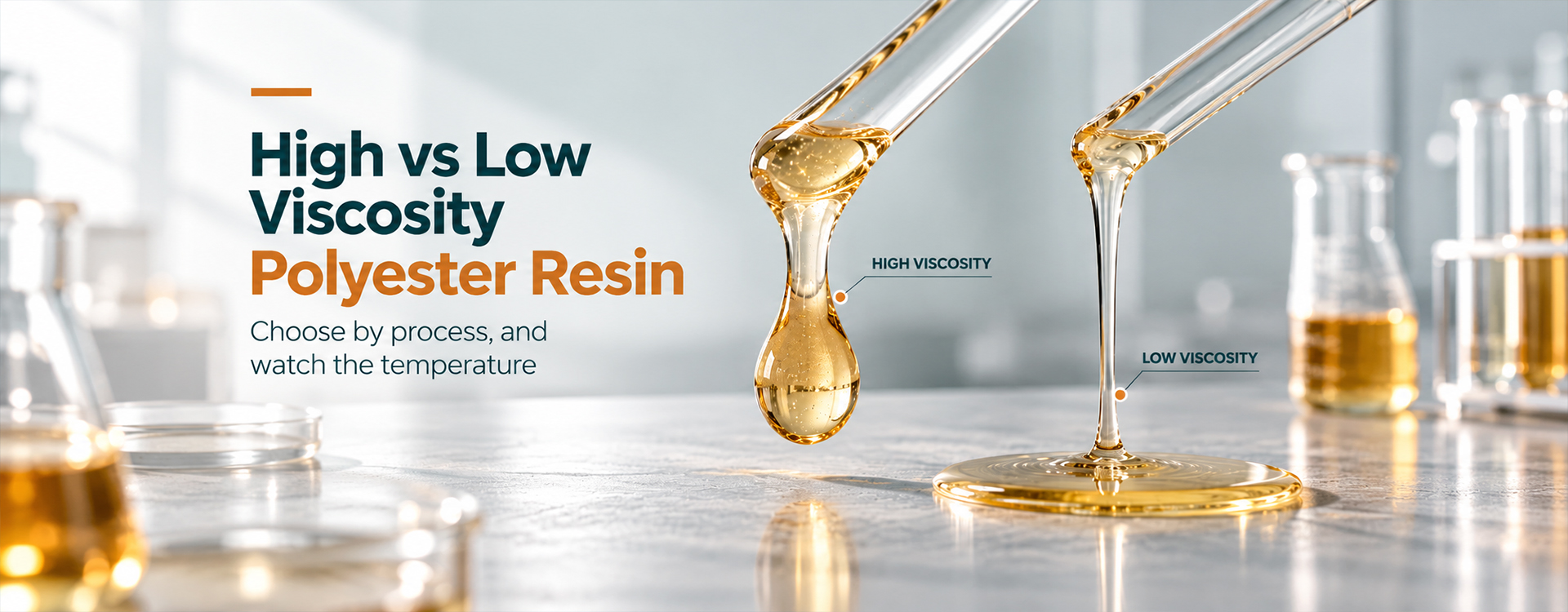
Viscosity is how thick a liquid resin is, and it decides a surprising amount of what happens in your shop. It controls how quickly resin soaks into glass fibre, whether it runs down a vertical mould, how much filler it can carry, and how easily trapped air escapes. Choose too thin and resin drains from where you need it. Choose too thick and you get dry spots and voids. This guide explains when each end of the range helps, and what to watch for.
What viscosity measures
Viscosity is resistance to flow. Water is thin; honey is thick. Resin data sheets report it in centipoise (cP) or millipascal-seconds (mPa·s), which are the same unit, usually measured with a Brookfield viscometer at a stated temperature.
Two points matter when you read the number.
- Temperature changes it sharply. Resin thins as it warms and thickens as it cools. The same drum will flow differently on a summer afternoon and a winter morning. Compare viscosities only at the same test temperature.
- Some resins are thixotropic. They thin while being stirred, brushed or sprayed, then thicken when left still. Gelcoats and some laminating resins are made this way on purpose, so a single viscosity figure does not tell the whole story. Some data sheets give a thixotropic index; if yours does not, ask your supplier whether the grade is thixotropic.
When low viscosity helps
- Wet-out of dense reinforcement. Thin resin penetrates fibre bundles faster and more completely, with fewer dry spots.
- Closed-mould and vacuum processes. Infusion and resin transfer moulding need resin that can travel long distances through the reinforcement before it gels.
- High filler loads. In casting and engineered stone, a thinner resin can carry more filler while staying workable.
- Air release. Bubbles rise and escape more easily from thin resin, which matters for clear casting.
The trade-offs: thin resin can drain from vertical surfaces, leaving resin-starved areas at the top and pooling at the bottom. Fillers may settle faster in storage or in the pot.
When higher viscosity helps
- Vertical and overhead surfaces. Thicker resin stays in place instead of running.
- Keeping filler suspended. A thicker resin holds particles in suspension longer.
- Controlled build-up. Where you want a thicker layer per pass, as with a gelcoat or a surfacing layer.
The trade-offs: slower wet-out, more rolling effort, and more risk of trapped air.
Matching viscosity to process
| Process | Usual viscosity preference | Main reason |
|---|---|---|
| Gelcoat application | High, thixotropic | Hold on vertical mould |
| Hand lay-up | Medium, often thixotropic | Wet-out without drain-out |
| Spray-up | Medium, thixotropic | Atomise well, then stay put |
| Infusion / RTM | Low | Travel through reinforcement before gel |
| Casting and engineered stone | Low to medium | Carry filler, release air |
| Grouting | Depends on gap and filler | Fill the space fully |
These are general preferences, not specifications. Your target viscosity depends on your mould, reinforcement, shop temperature and filler.
Why not just thin it yourself?
It is tempting to thin a resin in the shop by adding styrene, or worse, a solvent such as acetone. We advise against both without first talking to your supplier.
- Solvents do not take part in the cure. They can stay trapped in the part, weakening it and affecting the surface.
- Adding styrene changes the balance the resin was designed around. It can alter shrinkage, cured properties and emissions.
If a grade is too thick for your process, the better answer is a lower-viscosity variant of the same chemistry. VRP will adjust the styrene content to achieve the desired viscosity.
Viscosity in the VRP grade code
The third digit of a VRP grade code gives its viscosity class. A lower digit means a thinner resin and a higher digit a thicker one, read on the laminating-resin or gelcoat scale as appropriate. Some grades also carry a suffix: HV and LV mark high- and low-viscosity variants of the same chemistry, and ULV marks ultra-low viscosity. For example, VRP 4110-ULV is an ultra-low-viscosity version of our DCPD resin VRP 4110. See How to Read a VRP Grade Code.
At Vikram Resins
If a grade suits your chemistry but not your process, tell us your process, shop temperature and target viscosity. We can point you to a variant in our range, or discuss adjusting a grade for your requirement. Browse the full range and request a TDS, or contact our technical team.
FAQs
What is a low-viscosity resin used for?
Work that needs fast, thorough wet-out or long flow paths, such as infusion, resin transfer moulding, dense reinforcement, heavily filled casting and clear casting.
Why is my resin thicker in winter?
Viscosity rises as temperature falls. The same resin will feel noticeably thicker on a cold morning than on a warm afternoon.
Can I thin polyester resin with acetone?
We advise against it. Acetone does not take part in the cure and can remain trapped in the part. Ask your supplier for a lower-viscosity grade instead.
What do HV, LV and ULV mean in a VRP grade name?
High viscosity, low viscosity and ultra-low viscosity. They mark variants of the same chemistry that differ in flow.
What unit is resin viscosity measured in?
Centipoise (cP) or millipascal-seconds (mPa·s). One cP equals one mPa·s.