

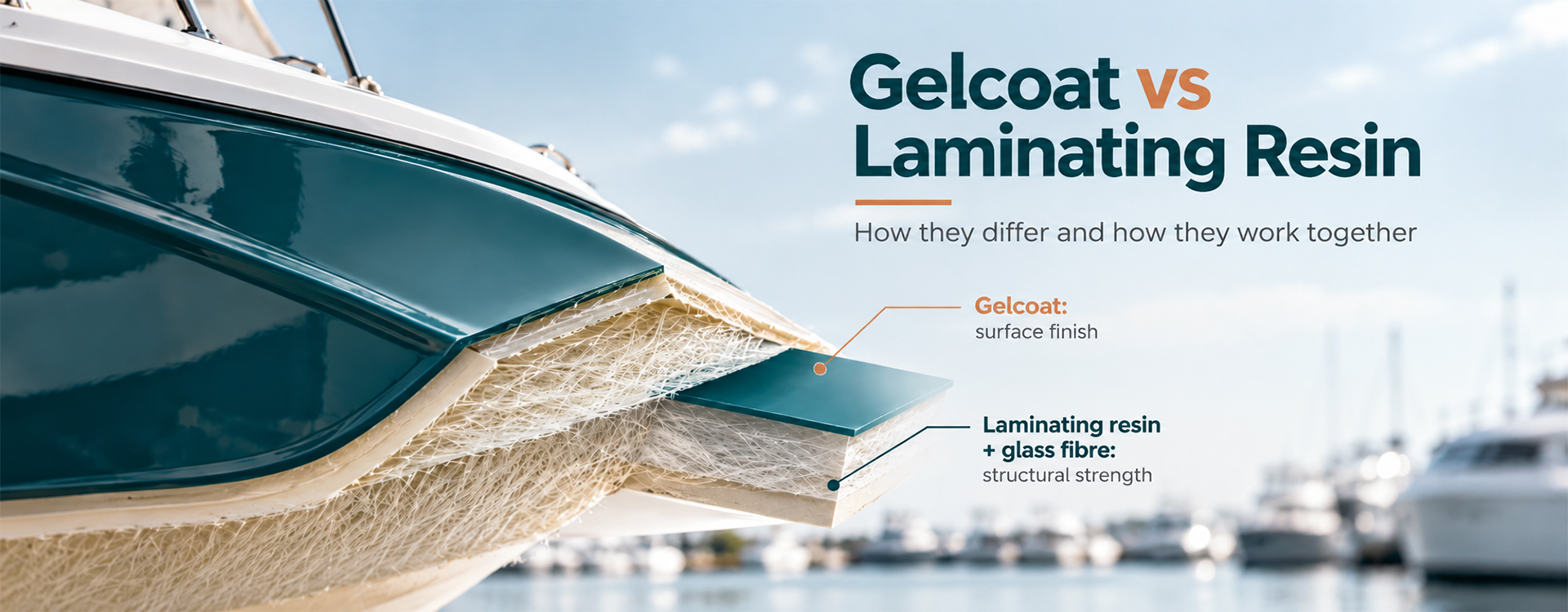
Most moulded FRP parts use two different polyester products. The gelcoat is the thin outer skin you see and touch. The laminating resin is what binds the glass fibre behind it into a strong structure. They can share the same backbone chemistry and still be designed for opposite jobs. Using one in place of the other is one of the most common causes of surface defects and early failures. Here is how they differ and how they work together.
What a gelcoat does
A gelcoat is the first layer applied to the mould, and it becomes the outside surface of the finished part. Its job is to give a smooth, coloured, durable face that protects the laminate underneath from sunlight, water, abrasion and chemicals.
To do that, a gelcoat is built differently from a laminating resin.
- It is thick and thixotropic. Thixotropic means it thins when brushed or sprayed, then thickens again as soon as it stops moving. This lets it hold on a vertical mould without running.
- It is usually pigmented, so the part comes out of the mould already coloured.
- It carries no reinforcement. It relies on the resin alone for surface hardness, gloss and weathering resistance.
What a laminating resin does
A laminating resin wets out the glass fibre mat or fabric and cures into a rigid composite. Its job is structural: carrying load, holding shape and bonding to the gelcoat.
- It is thinner, so it can soak through reinforcement quickly and push out air.
- It is usually unpigmented or lightly tinted.
- It is designed to perform together with fibre, not on its own as an exposed surface.
How they work together
In a typical open-mould process, the order is:
- Prepare and release-coat the mould.
- Apply the gelcoat to the mould surface in an even layer.
- Let the gelcoat cure until it is firm but still slightly tacky.
- Apply the laminating resin and reinforcement, rolling out air.
- Cure, then demould. The gelcoat is now the outer face of the part.
Timing at step 3 matters. Laminate too early and the solvent action of the fresh resin can wrinkle or lift the soft gelcoat. Laminate too late and the bond between gelcoat and laminate can be weak, which may lead to delamination. Ask your supplier for guidance on this window for your gelcoat and shop temperature.
Side by side
| Feature | Gelcoat | Laminating resin |
|---|---|---|
| Role | Outer surface finish and protection | Structural binder for reinforcement |
| Position in part | Outside face, applied first | Behind the gelcoat |
| Viscosity | Higher; thixotropic | Lower; free-flowing |
| Pigment | Usually pigmented | Usually unpigmented |
| Reinforcement | None | Glass fibre mat or fabric |
| Key properties | Gloss, colour, weathering, water and abrasion resistance | Wet-out, strength, stiffness, bond to gelcoat |
| Viscosity digit in VRP code | Read on the gelcoat scale | Read on the laminating scale |
Why the backbone still matters
A gelcoat takes the harshest exposure of any layer in the part, so its backbone chemistry matters. Isophthalic gelcoats are the usual choice for outdoor and water-contact surfaces because of their water and weather resistance. For interior or less demanding parts, other backbones can be a cost-effective choice. See Choosing the Right Polyester Resin Backbone.
Mistakes to avoid
- Using laminating resin as a surface coat. It will run on vertical surfaces, is not built for weathering, and can leave fibre patterns showing through.
- Applying gelcoat too thin. Thin areas may not cure properly and wear through quickly.
- Applying gelcoat too thick. Thick layers are prone to cracking and crazing.
- Leaving a surface tacky. Polyester cure is slowed by contact with air, so a surface open to the air can stay sticky. Grades formulated with wax, or a sealing coat, overcome this. Some VRP grades carry wax, shown by 3 as the fourth digit in the grade code.
- Not matching gelcoat and laminating resin. Ask your supplier to confirm the two are compatible.
Reading a VRP gelcoat code
Our gelcoats carry the word “Gelcoat” after the grade code, for example VRP 3116 Gelcoat or VRP 1120 Gelcoat. The digits read the same way as for resins, with one difference: the viscosity class, the third digit, is read on the gelcoat scale, because a gelcoat is deliberately thicker. See How to Read a VRP Grade Code.
At Vikram Resins
We make gelcoats and laminating resins across our backbone families, so we can advise on a matched pair for your part. Our range includes isophthalic, orthophthalic and terephthalic gelcoats, including a fire-retardant option. Browse the full range or ask our technical team which gelcoat suits your mould and service conditions.
FAQs
What is the difference between gelcoat and resin?
Gelcoat is a thick, usually pigmented surface layer applied first to the mould. Laminating resin is a thinner resin that binds glass fibre into the structure behind it.
Can I use laminating resin instead of gelcoat?
Not for an exposed surface. It runs on vertical moulds, weathers poorly and can show the fibre pattern.
Why is my gelcoat still sticky?
Polyester cure is slowed by contact with air. A surface open to the air may need a waxed grade or a sealing coat to cure tack-free.
When should I apply laminating resin over gelcoat?
When the gelcoat is firm but still slightly tacky. Too early risks wrinkling; too late risks a weak bond. Ask your gelcoat supplier for the right window.
Why does a gelcoat not sag on a vertical mould?
Because it is thixotropic: it thins while being applied, then thickens as soon as it stops moving.