

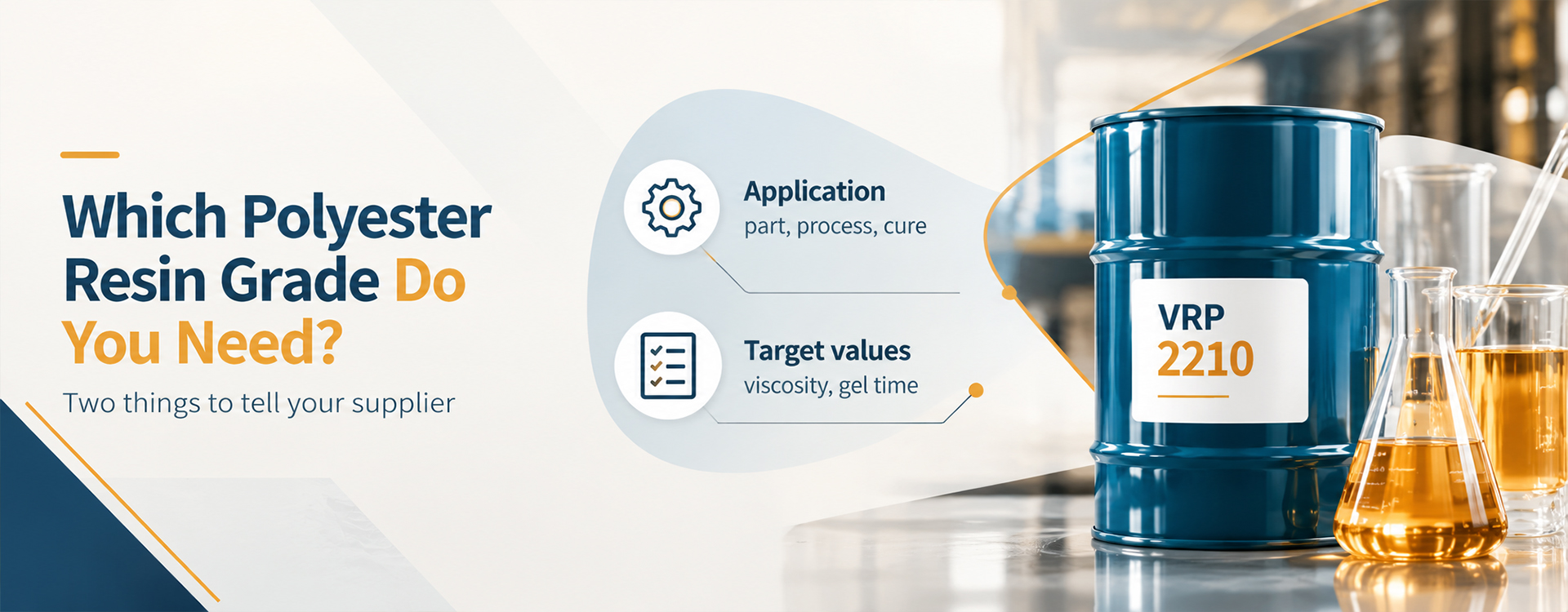
Many resin enquiries start with a single line: “We need a general-purpose resin. Please quote.” It is a reasonable request, but it forces the supplier to guess. A guess can mean a sample that does not suit your process, a second round of trials, and weeks lost. This guide shows you the two pieces of information that turn a vague enquiry into the right grade: your application, and the data-sheet values you need to meet.
Why "general-purpose" is not enough
Even within one backbone family, grades differ in viscosity, reactivity, accelerator status and additives. Two orthophthalic resins can both be called general-purpose and still behave very differently in your shop. One may gel too fast for a large mould in summer. Another may be too thin for a vertical surface. The supplier cannot tell which suits you without knowing how you will use it.
Thing one: your application
The application tells us which backbone and which variant to start from. Four questions cover most of it.
- What is the part? A boat hull, a water tank, an SMC body panel, a button, a marble slab, a pigment paste. The part points to the backbone. See Choosing the Right Polyester Resin Backbone.
- How will you process it? Hand lay-up, spray-up, casting, compression moulding, infusion, pultrusion or something else. The process sets the viscosity and reactivity you need.
- What will the part face in service? Water, chemicals, heat, sunlight, fire-safety requirements, or none of these. Service conditions decide whether a lower-cost backbone is enough.
- How do you cure it? Room temperature or heated, the catalyst you use, and whether you prefer to add your own accelerator. This decides between a pre-accelerated and a non-accelerated grade.
Thing two: your target data-sheet values
If you already use a resin, its data sheet is the most useful thing you can send. It tells us, in numbers, what your process is built around. If you do not have one, tell us the values you must meet. The ones that matter most are usually:
- viscosity, with the temperature it is measured at;
- gel time, with your catalyst type and dose;
- any cured property your customer specifies, such as heat deflection temperature or hardness;
- colour or clarity, if the part is visible;
- any mandatory certification or standard your end customer requires.
Not sure what these terms mean? Our guide How to Read a Resin Technical Data Sheet explains each one.
An enquiry checklist
| Tell us | Example | Why it matters |
|---|---|---|
| The part | FRP water tank, 1,000 litre | Points to the backbone |
| The process | Hand lay-up, open mould | Sets viscosity and reactivity |
| Service conditions | Potable water contact, outdoors | Decides between ortho and iso |
| Cure method | Room temperature, MEKP catalyst | Pre-accelerated or not |
| Current resin and its TDS | Supplier X, grade Y | Fastest route to a match |
| Must-meet values | Gel time 20–30 min at shop temperature | Narrows to a specific grade |
| Monthly volume | Approximate kg per month | Packaging and supply planning |
Putting it together: two worked examples
A fabricator makes general FRP panels by hand lay-up for indoor use. Cost matters most and service conditions are mild. That points to the orthophthalic family, first digit 2 in our grade code. If they add their own accelerator, a non-accelerated grade such as VRP 2110 is the starting point; if they want to add catalyst only, the pre-accelerated VRP 2210.
An automotive supplier compression-moulds SMC body parts. They need a high-reactive isophthalic resin that cures quickly under heat. That points to VRP 3115, listed on our range as a high-reactive isophthalic polyester for SMC and DMC.
In both cases, the grade code does half the work. See How to Read a VRP Grade Code.
What happens after you enquire
- We review your application and target values, and shortlist one or two grades.
- We send the TDS for each so you can confirm the fit on paper.
- You trial a sample on your own process. We charge a flat INR 500 / kg per sample. Minimum quantity is 1 kg and lead time is one week.
- If a standard grade does not meet your targets, we discuss a custom grade developed for your requirement.
- Once approved, every dispatch arrives with a CoA so your quality team can check each batch.
When no standard grade fits
Sometimes your targets fall between two grades, or your process is unusual. That is where a custom grade makes sense. The same two inputs, application and target values, are the starting point for that conversation.
At Vikram Resins
We make terephthalic, orthophthalic, isophthalic and DCPD-modified resins, plus gelcoats, so we can match the grade to your job instead of fitting your job to the one resin we make. Send us your application and, if you have it, your current data sheet. Browse our full range or talk to our technical team.
FAQs
What information do I need to give a resin supplier?
Two things: your application (the part, the process, the service conditions and the cure method) and the data-sheet values you must meet, ideally by sharing your current resin’s TDS.
Can I just ask for a general-purpose resin?
You can, but you will get a starting guess. Adding your process and target values gets you a grade that fits the first time.
What if I don't know my target values?
Tell us the part, the process and the service conditions. We can recommend a starting grade and you can confirm it with a sample trial.
Can VRP match my current supplier's resin?
Send us its TDS. It is the fastest way for us to identify the closest grade in our range, or to discuss a custom grade if none fits.
What happens if no standard grade fits?
We can discuss developing a custom grade for your requirement, starting from your application and target values.