

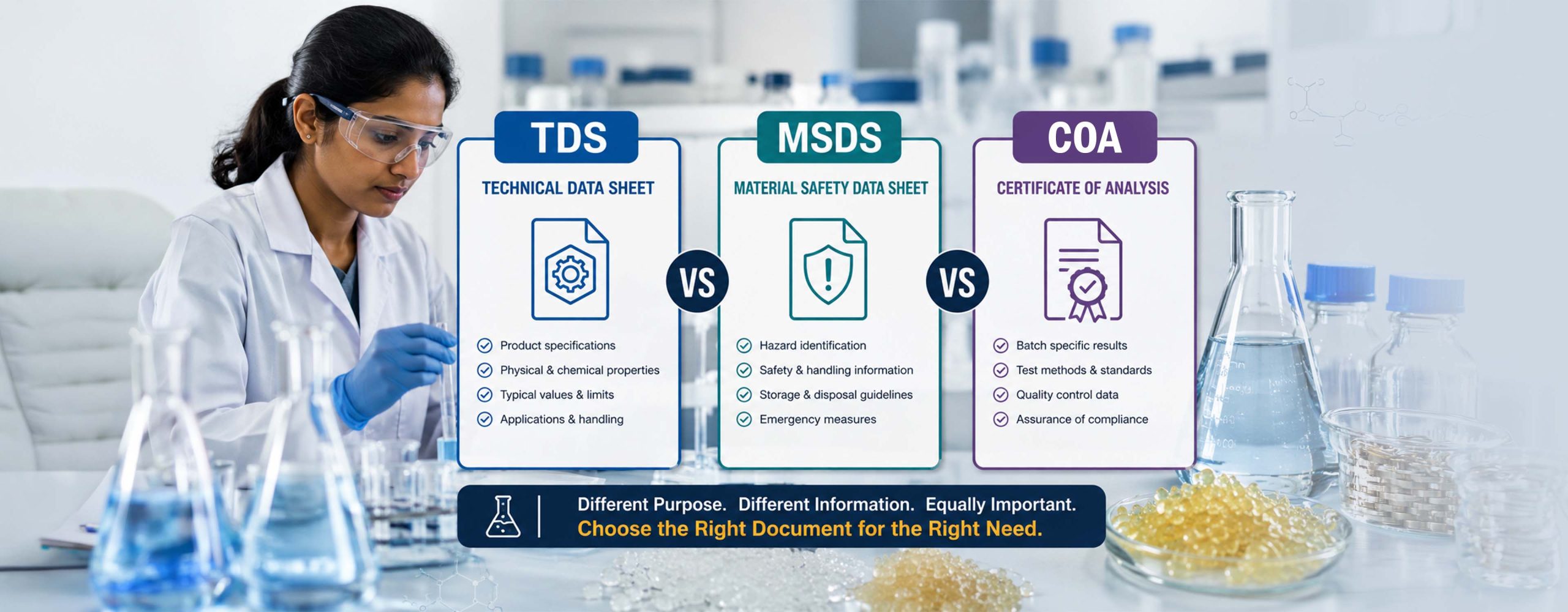
When you start working with a resin supplier, three acronyms come up quickly: TDS, MSDS, and COA. They are often used loosely, as if interchangeable. They are not. Each answers a different question, and asking for the right one saves time — and avoids the most common frustration in resin buying, the sample that seems not to “match” when in fact you were comparing the wrong two documents. Here is what each is for.
TDS — the Technical Data Sheet
The TDS is the “what it is and how to use it” document. It describes the grade’s typical liquid properties (such as viscosity, acid value, gel time and specific gravity) and its processing guidelines — catalyst and accelerator system, mix ratio, pot life and cure schedule — along with recommended applications and storage conditions. You use the TDS to select a grade and design your process around it. One crucial point: the figures on a TDS are typical or representative values for the grade. They describe what the product is designed to deliver — they are not a measurement of the specific drum you received. When looking to source a product from us, sharing a TDS of the properties you are looking for is the easiest way for us to match your requirements to a specific grade in our portfolio.
MSDS — the Material Safety Data Sheet
The MSDS is the safety and regulatory document. It follows a fixed 16-section international (GHS) structure covering hazards, safe handling and storage, personal protective equipment, first-aid and fire-fighting measures, spill response, transport classification and regulatory information. You use the MSDS to store, handle and transport the product safely and legally. For most unsaturated polyester resins the dominant hazard driver is styrene, so much of the MSDS is similar across grades — but pre-accelerated grades and fire-retardant grades carry additional hazard information, which is one more reason the document is grade-specific and worth reading. Styrene Monomer-free grades also have an accompanying MSDS, albeit simplified.
COA — the Certificate of Analysis
The COA is the batch-specific document. It reports the actual measured values for the specific lot you received, checked against the product specification. You use the COA for incoming quality control and traceability. This — not the TDS — is the document that corresponds to what is physically in your delivery.
The mistake to avoid
The most common confusion is comparing a measured COA value against a TDS figure and concluding the product is “off-spec.” In reality the TDS figure is a typical/nominal value, while the COA reports the real measured result for that batch within an allowed tolerance band. A viscosity that reads a little above or below the TDS nominal is usually a normal batch variation, not a defect. If you want to verify a delivery, compare the COA against the product specification — not against the TDS headline number.
Quick Reference
| Document | Answers | Batch-specific? | When you need it |
|---|---|---|---|
| TDS | What is it and how do I use it? | No (typical values) | Selecting a grade; designing your process |
| MSDS | How do I handle it safely and legally? | No (by grade) | Storage, handling, PPE, transport, compliance |
| COA | What exactly did I receive? | Yes (per lot) | Incoming QC and traceability of a delivery |
A practical sequence
Before requesting a sample, download the TDS to confirm the grade actually fits your application — this alone prevents most mismatched-sample disappointments. Request the MSDS separately for safe storage and transport. You do not need to ask for a COA — one accompanies every dispatch automatically, so your quality team can verify the specific batch the moment it arrives. Knowing which document does what, and when each one reaches you, is the mark of a buyer who knows what they are doing — and it makes the whole evaluation faster for everyone.
At Vikram Resins
We provide all three documents for every grade. Technical Data Sheets can be downloaded directly from our website. A Material Safety Data Sheet is available on request. And a Certificate of Analysis is sent automatically alongside every dispatch — you never need to ask for it. If you need anything you cannot find, contact our technical team and we will send it across.
FAQs
What is a TDS?
A Technical Data Sheet (TDS) describing a resin grade’s typical liquid properties, such as viscosity, acid value, gel time, and specific gravity, along with its processing guidelines. It is used to select a grade and design your process. The values shown are typical or representative for the grade, not measurements of the specific batch you receive.
What is an MSDS?
A Material Safety Data Sheet (MSDS) that follows the standard 16-section GHS format, covering hazards, safe handling and storage, personal protective equipment (PPE), first aid, fire-fighting measures, spill response, and transport classification. It is used to store, handle, and transport the product safely and in compliance with regulations.
What is a COA?
A Certificate of Analysis (CoA) that reports the actual measured values for the specific batch you receive, verified against the product specification. It is used for incoming quality control and traceability.
Is a TDS the same as a COA?
No. A TDS provides typical or nominal values for a resin grade, while a COA reports the actual measured results for the specific batch within the allowed specification limits. Comparing a COA value with the TDS instead of the product specification is one of the most common reasons buyers mistakenly conclude a delivery is off-spec.
Do I need to request a Certificate of Analysis (COA) separately?
No. A COA is sent automatically with every dispatch, allowing your quality team to verify the specific batch upon arrival. The MSDS, by contrast, is available on request.
When should I use a TDS, MSDS, or COA?
Use the TDS before requesting a sample to confirm the grade is suitable for your application and to plan your process. Request the MSDS for safe storage, handling, transport, and regulatory compliance. You do not need to request the COA — it is supplied automatically with every dispatch so your quality team can verify the specific batch received.