

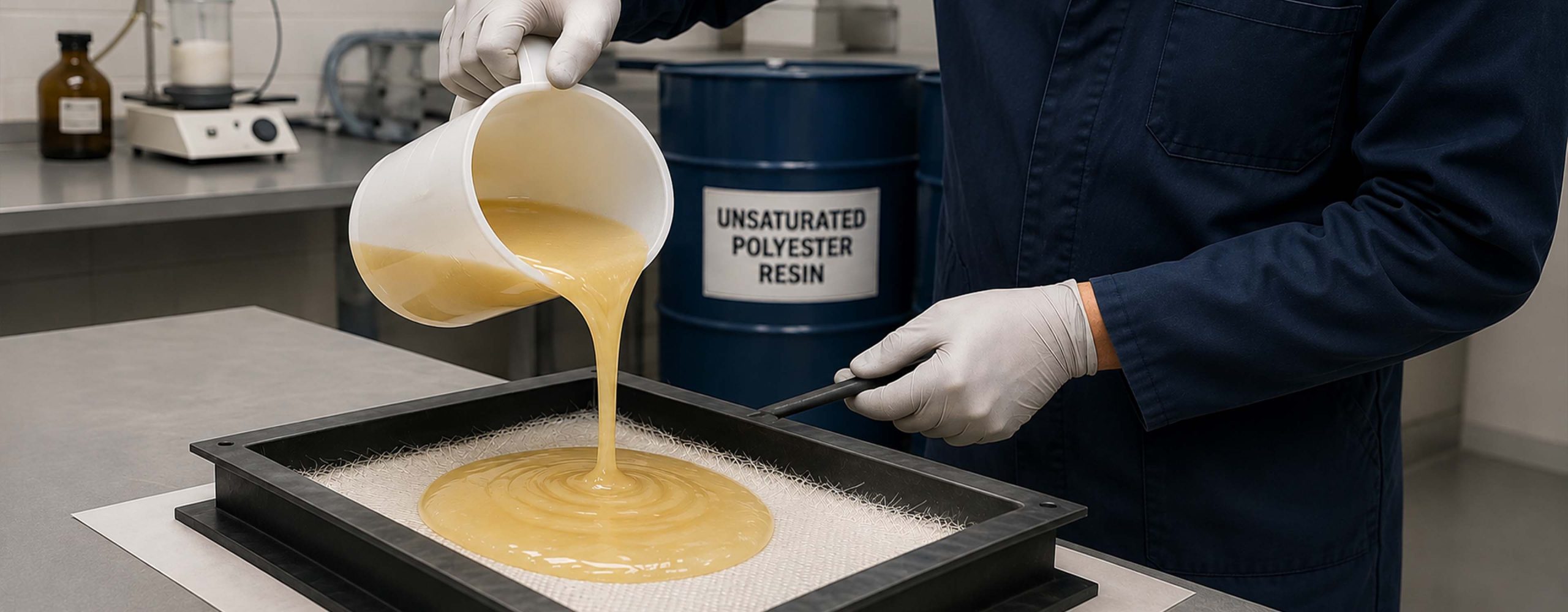
The single most consequential decision in selecting an unsaturated polyester resin is the backbone chemistry — the acid that forms the polymer’s spine. It is set long before any additive, pigment or filler enters the picture, and it governs the properties you cannot easily change later: water resistance, heat resistance, weatherability, toughness and cost. Vikram Resins manufactures four backbone families, and each one maps to the first digit of our grade code. Here is a plain-English guide to what each does best, and when to choose it.
Terephthalic (PET-based) — rigidity and value
Terephthalic resin is built on terephthalic acid, whose symmetric molecular structure produces a notably rigid, thermally stable backbone. In practice this delivers good stiffness and heat performance at a sensible cost, which makes the family popular for casting, decorative and button applications, and other work where hardness and dimensional stability matter. Its rigidity can mean less flexibility than other families, so the right formulation depends on the end-use. Choose it when you want rigidity and heat resistance at good value.
In a VRP grade code, terephthalic resins carry 1 as the first digit — see “How to Read a Vikram Resins and Polymers grade code.”
Orthophthalic — the workhorse
Orthophthalic resin, built from phthalic anhydride, is the most widely used and most economical polyester chemistry. It cures well, wets out reinforcement easily and performs reliably in general-purpose work — panels, general fibre-reinforced plastic mouldings, and components that are not exposed to aggressive water, chemicals or heat. Its limitation is the flip side of its strength: it offers lower hydrolytic (water) resistance and lower chemical and heat resistance than the isophthalic family. Choose it when cost matters most and the service conditions are mild.
In a VRP grade code, orthophthalic resins carry 2 as the first digit — see “How to Read a Vikram Resins and Polymers grade code.”
Isophthalic — the durable upgrade
Isophthalic resin, built from isophthalic acid, is the step up in durability. The change in molecular structure gives it meaningfully better resistance to water and chemicals, higher heat resistance, better mechanical performance and superior weatherability. This is why isophthalic chemistry is the default for marine laminates, chemical-resistant tanks and linings, water-contact applications, and outdoor gelcoats that must survive years of sun and moisture. It costs more than orthophthalic, and that premium buys longevity. Choose it when the part will face water, weather, chemicals or heat, and must last.
In a VRP grade code, isophthalic resins carry 3 as the first digit — see “How to Read a Vikram Resins and Polymers grade code.”
DCPD-Modified — low viscosity and low shrink
DCPD (dicyclopentadiene) modification changes the backbone so that the resin can carry a high reactive-diluent load while staying remarkably thin. The headline benefit is very low viscosity, which means fast, easy wet-out and excellent penetration into reinforcement. DCPD resins also bring low cure shrinkage, a good surface finish and lower styrene emission, all of which are valuable in casting, low-profile moulding and cost-effective lamination. The trade-off is that heat and chemical resistance are generally lower than isophthalic. Choose it when easy processing, low shrinkage and a clean surface are the priority.
In a VRP grade code, DCPD-modified resins carry 4 as the first digit — see “How to Read a Vikram Resins and Polymers grade code.”
Side By Side
| Property | Terephthalic | Orthophthalic | Isophthalic | DCPD |
|---|---|---|---|---|
| Water / hydrolytic resistance | Med–High | Low–Med | High | Medium |
| Heat resistance (HDT) | Med–High | Medium | High | Low–Med |
| Chemical resistance | Medium | Low–Med | High | Medium |
| Weatherability | Medium | Medium | High | Medium |
| Typical viscosity | Medium | Medium | Medium | Low |
| Relative cost | Low–Med | Low | High | Medium |
The ratings above are general and qualitative. Actual performance is grade-specific and also depends on the additives, reinforcement, styrene content and cure schedule used — always confirm against the data sheet for the specific grade.
The backbone is the foundation, not the whole story
Backbone chemistry sets the ceiling on what a resin can do, but the finished result also depends on the reinforcement, the cure system and the additives in the formulation. Two laminators using the same resin can get different results from different cure schedules. That is why the honest answer to “which backbone?” is usually: start from the service conditions, narrow to a family, then settle it with a sample trial against your own process.
How we can help
Because Vikram Resins makes all four families — plus gelcoats — we can recommend the right chemistry for your application objectively, rather than steering you toward the only thing we happen to make. Tell us the part, the service conditions and the process, and we will point you to the grade that fits, or develop one if your need is genuinely bespoke. Explore the range and download data sheets on our products page, or contact our technical team to talk it through.
FAQs
What is Terephthalic (PET-based) resin?
A resin built on terephthalic acid. Its symmetric molecular structure gives good stiffness, heat performance and dimensional stability at sensible cost, making it popular for casting, decorative and button applications where hardness matters.
What is Orthophthalic resin?
The most widely used and most economical polyester chemistry. It cures well, wets out reinforcement easily and performs reliably in general-purpose FRP work, but offers lower water, chemical and heat resistance than isophthalic — best when cost matters most and service conditions are mild.
What is Isophthalic resin?
A step up in durability, with meaningfully better resistance to water and chemicals, higher heat resistance, better mechanical performance and superior weatherability than orthophthalic. It costs more, and that premium buys longevity.
What is DCPD resin?
A DCPD-modified backbone that carries a high reactive-diluent load while staying very thin, giving fast wet-out, low cure shrinkage, a good surface finish and lower styrene emission. Heat and chemical resistance are generally lower than isophthalic.
Which resin backbone is best for marine applications?
Isophthalic resin is the default for marine laminates because of its superior water resistance, chemical resistance and weatherability.
How do I select the right resin backbone?
Start from the service conditions the part will face, narrow to a backbone family, then confirm the choice with a sample trial against your own process — the finished result also depends on the reinforcement, cure system and additives used. If unsure, refer to our Technical Data Sheets, which specify ideal use cases for all our product grades.