

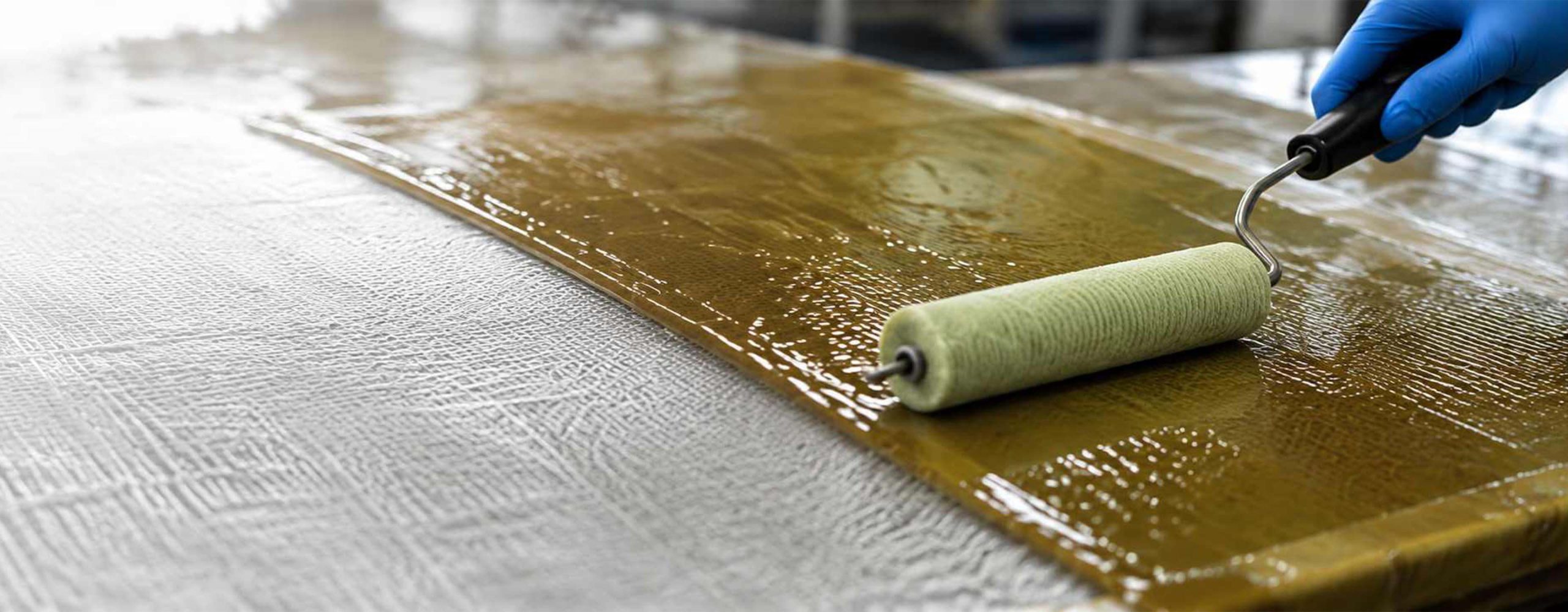
Every Vikram Resins product carries a four-digit grade code — VRP 1110 Resin, VRP 3116 Gelcoat, VRP 4110-ULV Resin, and so on. Those digits are not arbitrary. Each one tells you something specific about the resin: its base chemistry, whether it is pre-accelerated, its viscosity class, and its specialty. Learn to read the code and you can often shortlist the right grade before you even open the data sheet. Here is how the system works.
The anatomy of a code
A VRP grade code is the letters VRP followed by four digits, sometimes with a short suffix. Reading left to right, each digit answers one question.
First digit — the base chemistry
This is the most important digit. It tells you the “backbone” of the polymer — the acid family that determines the resin’s core behaviour:
1 – Terephthalic (PET-based) Polyester: a rigid, value-oriented backbone with good heat resistance.
2 – Orthophthalic: the general-purpose, cost-effective workhorse.
3 – Isophthalic: the durable upgrade, with better water, chemical and weather resistance.
4 – DCPD Modified: a low-viscosity, low-shrinkage specialty backbone.
If you want the full picture of what each backbone means for performance, see our companion article, Choosing the Right Polyester Resin Backbone.
Second digit — accelerator
This tells you whether the resin is supplied ready-accelerated:
1 – Without Accelerator: you add the accelerator (typically a cobalt compound) along with your catalyst at the point of use.
2 – Pre-Accelerated: the accelerator is already in the resin, so you only add catalyst.
This matters for more than convenience. A pre-accelerated resin has a different pot life and a different safety profile, which is why its Safety Data Sheet differs from the non-accelerated version of the same chemistry.
Third digit — viscosity class
This places the grade in a viscosity band — broadly, how thick the liquid resin is. For laminating resins, a “1” indicates a thinner, free-flowing resin and a “2” a thicker one. Gelcoats use higher thresholds than laminating resins, because a gelcoat is deliberately formulated to be thick so it does not sag on a vertical mould. In other words, the same digit means different absolute viscosities depending on whether the product is a laminating resin or a gelcoat — the band is always read in the context of the product family.
Fourth digit — specialty
The final digit identifies a specialty or formulation type within the family. For example, one value denotes a styrene-monomer-free pigment-base grade; another denotes a high-reactive grade developed for sheet moulding compound (SMC). Because these designations are specific to our range, the simplest path is to tell our technical team the property you need and let us point you to the right grade. We currently offer 9 specialties, namely: 0 = General Purpose | 1 = TEA-based | 2 = Premium PET | 3 = with Wax | 4 = Styrene Monomer-free | 5 = High Reactive | 6 = Medium Reactive | 7 = with Promoter | 8 = Fire Retardant | 9 = Clear Cast
Suffixes: variants outside the digits
Some products carry a suffix that sits outside the four-digit logic, for clarity rather than to encode a new property. “Gelcoat” marks a gelcoat version of a resin family. HV and LV distinguish high and low-viscosity variants of the same backbone — for instance VRP 3117-HV and VRP 3117-LV share one chemistry and differ only in flow. ULV marks an ultra-low-viscosity grade where the flow is so distinctive it deserves calling out by name.
Putting it together

VRP 3115 reads as: isophthalic base (3), supplied without accelerator (1), lower-viscosity class (1), high reactive (5) — an isophthalic resin built for SMC.
VRP 2124 reads as: orthophthalic (2), without accelerator (1), higher-viscosity class (2), styrene-monomer-free (4) — an orthophthalic pigment-base grade.
Once the logic clicks, the whole range becomes self-explanatory.
Why we publish this?
A systematic code reflects a systematic operation. Being able to decode a grade name lets you narrow your options quickly and request the right data sheet the first time — which is exactly the kind of friction we want to remove from working with us.
If you are unsure which grade fits your application, our technical team will decode the requirement with you.
Browse the full range and download any data sheet on our products page, or contact us to discuss a specific application.
FAQs
What is a VRP grade code?
It is the letters VRP followed by four digits, sometimes with a short suffix. Each digit identifies one property of the resin: its base chemistry, whether it is pre-accelerated, its viscosity class and its specialty type.
What does the first digit of a VRP grade code mean?
The first digit identifies the base chemistry: 1 for terephthalic, 2 for orthophthalic, 3 for isophthalic, and 4 for DCPD-modified.
What does the second digit of a VRP grade code mean?
The second digit shows whether the resin is pre-accelerated: 1 means the accelerator must be added separately at the point of use, 2 means the accelerator is already included and only catalyst needs to be added.
What do the third digits of the code mean?
The third digit places the grade in a viscosity band, read differently for laminating resins versus gelcoats since gelcoats use higher thresholds.
What do fourth digits of the code mean?
The fourth digit identifies a specialty or formulation type within that family, such as a styrene-monomer-free or SMC-specific grade.